The 6:15 Express Is a Rolling Light Studio: A Commuter's Guide to Train-Window Bokeh
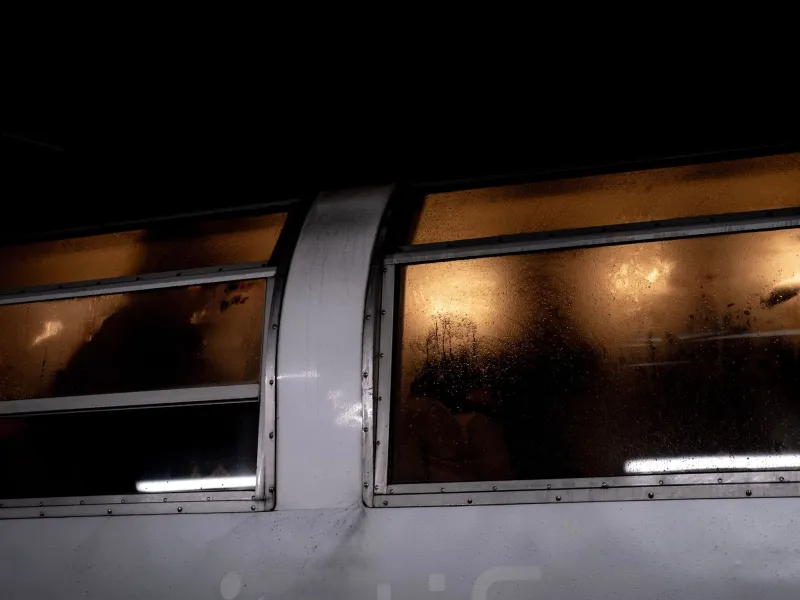
There's a moment on every commuter rail line in America that most riders sleep through. The train clears the last station before the tunnel, the platform lights swing past, and suddenly the windows fill with a parade of orange sodium orbs, streaking headlights, and smeared storefront neon. It lasts maybe ninety seconds. For most of the car, it's time to check email. For you, it's the best free light show in the city.
If you ride the Long Island Rail Road, BART, Chicago's El, or basically any rail line that runs above or below a city, you're sitting on a rolling bokeh lab — and you're riding it five days a week whether you use it or not.
Why Trains Are Secretly Perfect for This
Bokeh lives and dies on point sources of light, and commuter corridors are absolutely stuffed with them. Streetlamps pass in rhythm. Car headlights and taillights stack up in red-and-white chains. Signal lights, crossing gates, parking lots, billboards — it's an endless conveyor of highlights at exactly the kind of distances that make background blur melt into circles.
Then there's the glass. Train windows are usually dirty, sometimes wet, occasionally vibrating. Sounds like a problem, right? It's actually the opposite. A slightly grimy window diffuses highlights the way a cheap filter would, softening everything outside into a painterly smear. Add rain and you get streaked, doubled points of light that no lens alone can produce.
And the tunnel sections? Those are your black frames. Pure darkness between bursts of light, which gives your bokeh contrast and rhythm. Shooting through a tunnel with the right settings turns passing lights into strobing ribbons.
Settings That Actually Work at 50 MPH
Shooting from a moving train is a negotiation between three forces: the train's motion, your hand tremor, and the light outside. Here's a baseline that holds up across most conditions.
Start wide, then stop down. Open your aperture to f/1.8–f/2.8 to grab light and to throw everything beyond the window into blur. If your shots feel too smeared, close down to f/4 — you'll lose some creaminess but gain consistency.
Shutter speed is your steering wheel. Around 1/250s freezes the scene decently if the train is moving smoothly. Drop to 1/60s or slower and the lights start streaking into lines — sometimes a happy accident, sometimes mush. Experiment deliberately: shoot a burst at 1/500, 1/125, and 1/30 and see which character you like. Tunnel sections forgive slow shutters because everything is motion anyway.
Crank ISO without guilt. Modern sensors handle ISO 3200–6400 with grace. A little noise in a moody train-window shot reads as atmosphere, not failure.
Focus through the glass, not on it. If your autofocus keeps grabbing the window grime or a smudge, switch to manual focus and set roughly to infinity. At those distances, everything outside is effectively at the same focal plane anyway — and the blur does the rest.
Brace like you mean it. Elbows in, camera pressed to the window frame or a rolled-up jacket. Vibration from the rails is sneaky; a two-point brace doubles your keeper rate.
The Rain Bonus
Pick a drizzly evening and the game changes completely. Water droplets on the glass become hundreds of tiny lenses, each one rendering the lights outside as micro-bokeh. Shoot wide open with the droplets slightly out of focus and you get a dreamy, layered effect — sharp light bleeding through soft water. It's the same trick as the wet windshield classic, but you don't have to stand in a parking lot to get it.
Pro move: breathe on the glass near the edge of the frame for a fogged vignette that fades your bokeh into darkness.
Route Notes: Three Lines, Three Personalities
The LIRR and Metro-North (NYC): Elevated and surface stretches through Queens and the Bronx deliver dense street grids — meaning tight, repeating orbs of amber and white. Evening rush in autumn, when the sun drops early, is prime time.
BART (Bay Area): The Transbay Tube approach and the elevated sections through Oakland give you long sightlines and big, spread-out light sources. Wider bokeh balls, fewer of them, more breathing room in the frame.
The El (Chicago): This is the crown jewel. The Loop turns the city into a canyon of reflected light, and the elevated structure means you're shooting over traffic — taillight streams, marquee signs, that unmistakable Chicago glow. Ride it at blue hour, not full dark, and you get a cool-blue sky behind warm bokeh. Chef's kiss.
The Case for the Wasted 40 Minutes
Here's the honest pitch: the average American commuter spends close to an hour a day in transit. That's roughly 250 hours a year — enough time to get genuinely, measurably better at a craft. Most people spend it scrolling. You could spend it doing reps.
Train-window shooting is low stakes and high volume. Nobody's waiting on you. There's no client, no posed subject, no pressure. You can burn through a hundred frames in a ride home and only care about three of them. That's how you build an eye — not in the once-a-year golden hour, but in the grind of repeated looking.
And there's something quietly poetic about it. The commute is the most standardized, beige, vanilla stretch of the American day. Same seat, same stops, same announcements. But the light coming through that window is never the same twice — different weather, different hour, different season. The blur is always new even when the route isn't.
So tomorrow, instead of opening your phone when the doors close, raise the camera instead. The 6:15 is leaving whether you're ready or not. Might as well make something on the way.