Midway After Dark: Turning America's County Fairs Into a Bokeh Playground
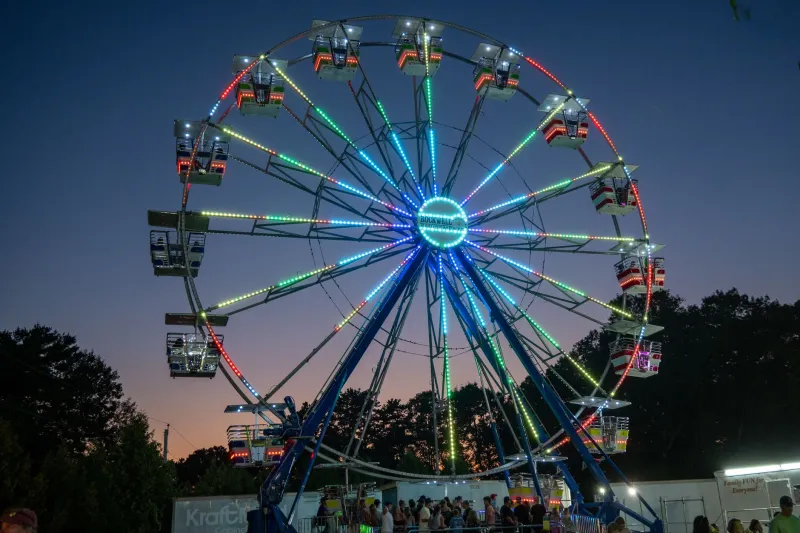
There's a moment at every county fair when the sun drops behind the grandstands and the midway flips the switch. One second it's a gravel lot full of livestock trailers and funnel cake trailers. The next, it's a wall of incandescent color — thousands of bulbs wrapped around the Ferris wheel, the Tilt-A-Whirl, the Gravitron — all of it reflected in the eyes of every kid clutching a stuffed animal.
For photographers, this is the Super Bowl of background glow. Nothing else in American life packs this much point-source light into a walkable half-acre. And unlike a city skyline, the lights move. They spin, flash, and pulse in patterns that turn every out-of-focus highlight into a living thing.
Here's how to make the most of fair season, wherever your state's edition happens to land.
Timing the Switch: When the Midway Comes Alive
The single biggest mistake fair shooters make is showing up too early. Golden hour is lovely, sure, but the rides are half-lit and the sky still fights your highlights. The magic window is roughly 20 to 40 minutes after sunset — what photographers call civil twilight, when the sky glows deep blue but the carnival bulbs read as bright, clean points of light.
That blue-hour balance is everything. A deep cobalt sky gives your bokeh something to sit against. Shoot the same Ferris wheel at 9 p.m. and again at 9:40 and you'll get two completely different photos — the first a warm wash of ambient light, the second a cluster of jewels floating in darkness.
Stay late, too. By 10:30 the crowds thin, the ride operators get loose, and you can often talk your way onto the platform for a lower angle. Fair folks are friendlier than you'd think, especially if you buy a lemonade first.
Settings That Do the Heavy Lifting
You don't need exotic glass, but a fast lens helps enormously. A 50mm f/1.8 — the cheapest lens in most camera bags — will turn a row of game booth bulbs into a wall of soft orbs. Longer lenses compress the light field, which is why a 85mm or 135mm makes the midway look twice as dense as it actually is.
A few starting points:
- Blue hour ride shots: f/2.8, 1/125s, ISO 800. Fast enough to freeze the Ferris wheel's structure while the background melts.
- Full-dark motion work: f/5.6 to f/8, shutter speeds between half a second and two seconds, ISO 100. Ride lights become ribbons of color.
- Portraits on the midway: Wide open at f/1.8, shutter around 1/200s, ISO auto with a cap around 1600. Let the crowd and booths collapse into glow behind your subject.
Brace yourself against a fence post, a trash can, or the base of the Tilt-A-Whirl for longer exposures. Or bring a small tripod and embrace the looks you'll get. Fairgoers will assume you're somebody important.
One Frame, Two Kinds of Blur
The signature midway shot combines motion blur in the subject with creamy bokeh in the background — a spinning ride rendered as streaks of light against a field of soft orbs. It sounds tricky, but it's mostly a matter of shutter speed selection.
Start around 1/4 second. That's slow enough to smear the spinning lights of a ride into circular trails, but fast enough that static elements — the ride's frame, the sign, the guy selling fried dough — stay recognizable. Your background bulbs become round bokeh because they're out of focus; the ride lights become streaks because they're moving. Two effects, one exposure.
Want the trails to trace perfect circles? Shoot the Ferris wheel straight on. Want dramatic arcs? Get low and off-axis. And if you pan with a slower ride, you can keep the ride sharp-ish while the entire midway behind it smears into painterly streaks — a completely different look from the same vantage point.
Beyond the Rides: The Unsung Bokeh of the Fair
The Ferris wheel gets all the glory, but the fairgrounds are full of quieter opportunities. Game booths strung with colored bulbs make gorgeous backdrops for candids. The food trailers — all stainless steel and fluorescent glow — produce beautiful specular highlights at f/2. Steam rising off a griddle under a single warm bulb at blue hour? That's a magazine cover.
Even daytime has its moments. Sunlight filtering through a barn's slatted walls, dust kicked up over the rodeo arena, prize pumpkins under a tent canopy — all of it rewards a shooter who thinks about what's behind the subject, not just the subject itself.
A Quick Word on Etiquette
Ask before photographing kids who aren't yours, tip your ride operators if they help you out, and don't set up a tripod in the middle of a walkway during peak hours. Fair workers deal with enough chaos. A little courtesy gets you access that money can't buy — including, occasionally, a behind-the-scenes pass to shoot the rides from the operator's platform. Trust us: the view from up there, looking down at the whole midway as a sea of blur, is worth every fried Oreo.
Fair season runs from now through October across most of the country. Grab your fastest lens, charge your batteries, and go chase the glow.